Where the Rain Goes on a Roof: From the Ridge to the Gutter to the Ground
On 1 and 2 September 2021, a rain gauge in North Arlington collected 9.02 inches. Here is the path that water takes across a roof, layer by layer and joint by joint, and the places where it leaves the path.
A nine-inch night
Ida's remnants dropped 9.02 inches on the New Jersey Weather and Climate Network's North Arlington gauge between 1 and 2 September 2021, with most of that falling in roughly six hours. Over the same two days Newark Airport logged 8.44 inches, and in Lyndhurst the single hour ending 9:30 PM brought 3.58.
Rutgers' water resources program supplies a way to picture it: an 800-square-foot roof collects about 500 gallons for every inch of rain. Scale that to 9.02 inches and the answer lands near 4,500 gallons, which is simple multiplication rather than a measurement. It still shows how much a roof handles on a bad night.
The route of a raindrop, stage by stage
Shingle surface
Sheds most of the water
First sign of trouble: grit in the downspouts, curled edges
Underlayment
Backs up the shingles
First sign of trouble: a stain inside with no visible hole
Flashing
Seals chimneys, walls and vents
First sign of trouble: a stain beside the chimney or wall
Valley
Carries the water of two slopes
First sign of trouble: a stain below the line where slopes meet
Eave
Hands water to the gutter
First sign of trouble: ice at the edge, a stained soffit
Gutter
Collects the runoff
First sign of trouble: overflow in an ordinary rain
Downspout
Ends the trip at the ground
First sign of trouble: wet foundation or driveway at its foot
The stack under the shingles
Shingles are the visible layer, and they turn away most of the water. Beneath them lies underlayment, a sheet meant to resist water if any gets past, and below that the deck of boards or plywood that carries everything. FEMA's technical fact sheet on shingles for high-wind regions asks for underlayment under every installation.
The Department of Energy's repair brief gives two typical builds: a single layer of 30-pound felt lapped 2 inches, or in place of that two 15-pound layers. The overlaps do a simple job. Water that slips past one layer meets the next and keeps running downhill.
Edges, where the water leaves
The eave is where the roof passes its water to the gutter. FEMA's fact sheet calls for a starter strip along the eave and six nails per shingle there, roofing nails rather than staples. A weak edge is where wind lifts the first course and lets rain underneath.
Winter turns the eave into the place where ice builds. As UMass's building-science group describes it, snow melts over the heated part of the roof, then freezes again once it reaches the cold overhang, and the water that backs up behind that ice finds its way under the shingles. The Building America guide recommends self-adhering membranes around eaves, valleys, dormers and chimney penetrations.
Metal at the joints
Wherever a roof meets something else, metal takes over. Along a wall, the Building Science Corporation's flashing details show step flashing woven in with the shingles and kick-out flashing at the bottom that steers water away from the wall. At a chimney, counterflashing is set into the mortar joints and laps over the base flashing.
The National Park Service's roofing brief calls a failure in the flashing system usually a major reason roofs deteriorate, and the asphalt roofing trade group's post-Sandy guide names flashings as the most vulnerable part of a roof. A leak beside a chimney or a wall is worth tracing to the joint before anyone replaces a shingle.
When the roof is almost flat
Low-slope roofs drain slowly by design; the Department of Energy draws the line at a pitch no steeper than 2:12. The Asphalt Roofing Manufacturers Association says water still sitting there 48 hours after the rain is ponding, gives 1/4 inch of fall per foot as the minimum slope, and points to drains and scuppers as the exits. Freeze and thaw can scrub a membrane where water sits.
The usual coverings are single-ply sheets, built-up layers and modified bitumen, each installed differently. A puddle still there two days after the rain is a fair question to put to a roofer.
Gutters, downspouts and the ground
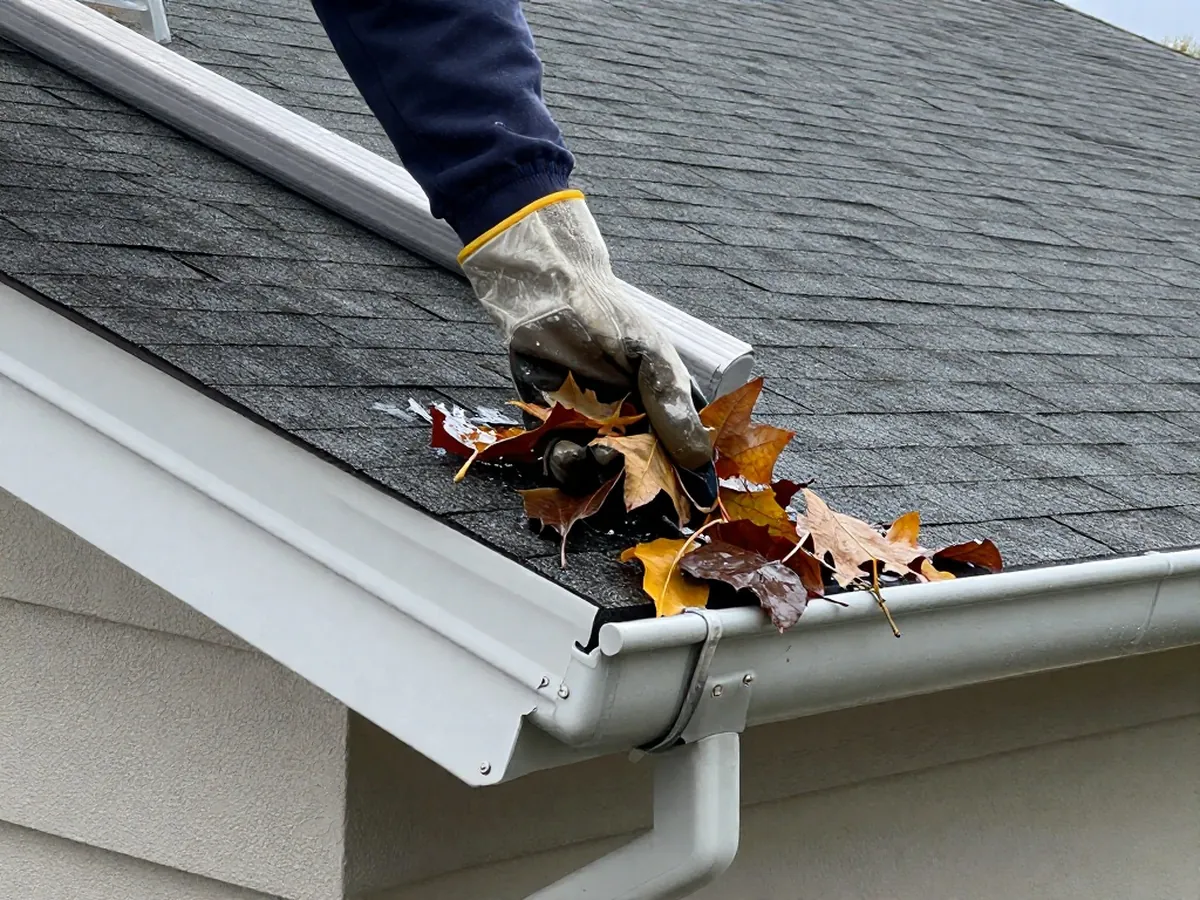
A gutter collects what the roof sheds, and a downspout carries it to the ground. The National Park Service's brief ties a roof's success to frequent cleaning and repair of the gutter system, because debris blocks the flow and sends water backing up beneath the roofing. The Rutgers rain barrel page suggests sending downspouts to a spot where water can soak in, and the EPA's page on redirecting them cautions that it is not right for every property and that local regulations apply.
Where the water lands matters too. Bergen County's hazard plan puts about 21 percent of North Arlington's land in the mapped floodplain, and the CDC's guidance for flooded homes says rainwater from gutters or the roof needs to drain away from the house.
Which sign on your roof is worth a call?
Stains on a ceiling, grit in the downspouts, a gap beside the chimney or water that stays on a flat section are the usual first signs. A stain that grows with every rain points to roof repair, and water on the ground by the wall points to gutters and downspouts.
Next step: call __PHONE_DISPLAY__ and say which sign you are seeing and where; the street address, and a yard photo if you took one, move things along.
Where the facts come from (15)
- NJ Weather and Climate Network, Remnants of Ida strike New Jersey
- Rutgers Water Resources Program, Rain barrels
- FEMA, Technical Fact Sheet No. 7.3, Asphalt Shingle Roofing for High-Wind Regions (copy hosted by the City of Goose Creek, SC)
- U.S. Department of Energy, Repairing Roofs and Ceilings technical brief
- Asphalt Roofing Manufacturers Association, Assessing roof damage after Superstorm Sandy
- Building Science Corporation for DOE Building America, Common Flashing Details for All Climates
- Building America Solution Center (PNNL), Chimney flashing and counterflashing overlaps
- National Park Service, Preservation Brief 4: Roofing for Historic Buildings
- Asphalt Roofing Manufacturers Association, Ponding water basics
- U.S. Department of Energy, Energy Saver: Cool roofs
- U.S. EPA, Soak Up the Rain: Disconnect/Redirect Downspouts
- CDC, Safety Guidelines: Reentering Your Flooded Home
- Bergen County, 2026 Hazard Mitigation Plan, Section 4 Risk Assessment (Table 4.6-1)
- UMass Amherst Building and Construction Technology, Preventing ice dams
- Building America Solution Center (PNNL), Construct roofs and attics for ice dam prevention
Checked 1 Nov 2026